Skip to content

Imagine a cracked vase.
The fracture doesn’t disappear, but when it is repaired with gold, it becomes more beautiful and unique than before.
This Japanese art, known as kintsugi, mirrors something psychology has been studying for decades: post-traumatic growth.
Post-traumatic growth does not mean “getting over it quickly” or “erasing the pain.”
Instead, it acknowledges that life will never be exactly the same — and yet it can still reveal new meaning, deeper values, and stronger connections.
The scar remains, but it becomes part of your strength.
In this article, I’ll walk you through what science tells us about this phenomenon.
You’ll discover its definition, the five stages that researchers have mapped, the tools that support growth, and real-life examples that show this is not about romanticizing trauma, but about expanding the possibilities of human resilience.

Choose How You
Want to Learn
Lesson 1 — Understanding What Post-Traumatic Growth Really Means
So, what is post-traumatic growth?
Psychologists Richard Tedeschi and Lawrence Calhoun coined the term in 1996 to describe the positive psychological change that can emerge after highly challenging life events.
They defined it as “the experience of positive change that occurs as a result of the struggle with highly challenging life crises.”
In other words, growth is not about avoiding suffering, but about what can develop through working with it.
Tedeschi and Calhoun identified five areas where post-traumatic growth tends to appear:
- A greater appreciation for life — noticing the value of everyday moments.
- Improved relationships — deepening connections and valuing closeness.
- New possibilities — discovering opportunities or directions not considered before.
- Personal strength — recognizing an inner resilience that was not obvious prior to the trauma.
- Spiritual or existential change — shifts in beliefs, faith, or sense of purpose.
It’s important to distinguish this from resilience.
Resilience is about “bouncing back” to baseline after adversity.
Post-traumatic growth, on the other hand, is about transformation — moving forward into a new version of yourself, shaped by both pain and meaning.
Science confirms that this is not a rare phenomenon.
A large meta-analysis of 26 studies found that over half of trauma survivors reported moderate to high levels of post-traumatic growth (Wu et al., 2019, Journal of Affective Disorders).
This shows that while trauma often leaves lasting scars, many people also describe positive psychological changes as part of their recovery journey.
And trauma is not only personal.
It can also be collective or even inherited, shaping the way families and communities experience suffering and healing.
This is often referred to as generational trauma, a reminder that growth can ripple across time just as pain does.
In short, post-traumatic growth does not mean the trauma was “worth it” or that suffering is desirable.
It means that within the cracks of hardship, the human mind has the potential to grow in unexpected and profound ways.
How Well do You Manage Anxiety?
Discover your personal anxiety profile in just 3 minutes. Get science-based insights into your emotional patterns — and a practical next step tailored to your results.
Discover your personal anxiety profile in just 3 minutes.
Get science-based insights into your emotional patterns
— and a practical next step tailored to your results.
Lesson 2 — The 5 Stages of Post-Traumatic Growth
Researchers Richard Tedeschi and Lawrence Calhoun (2004) proposed that post-traumatic growth unfolds in stages.
These stages are not a strict sequence, and not everyone experiences all of them in the same order or intensity.
Still, they provide a helpful framework for understanding how transformation can gradually emerge after trauma.
The Trauma and Its Impact
This first stage begins with the event itself — an accident, illness, loss, or other profound disruption. Life feels broken, and old assumptions about safety, fairness, or control may shatter. For example, someone who survives a car accident might suddenly see the world as unpredictable and dangerous.
Struggle and Emotional Turmoil
In the second stage, emotions surface with full force: fear, sadness, anger, or even numbness. This struggle can feel overwhelming, but it is also where growth begins. The mind is working hard to make sense of what happened. For instance, a person facing cancer treatment may feel grief for their old life, while also questioning what really matters.
Searching for Meaning
Here, the survivor begins to reflect more deeply. Why did this happen? What can I learn from it? This stage is about rebuilding a personal worldview, not with easy answers, but with new perspectives. Someone who has lost a loved one might start volunteering in support groups, transforming pain into a search for meaning.
Integration of Change
The fourth stage involves weaving new insights into daily life. Relationships may shift, priorities may realign, and values may deepen. For example, a veteran returning from war may find new closeness with family or pursue a different career path that feels more purposeful. The trauma remains part of the story, but it no longer defines the entire narrative.
Expansion into a New Life
Finally, growth takes root as the person embraces a “new normal.” This does not erase loss or pain, but it allows for resilience and even flourishing. A survivor of domestic violence, for instance, may become an advocate for others, channeling past suffering into empowerment and community change.
It is crucial to remember that these stages are not linear checkboxes.
Healing is personal and often cyclical.
Some may move forward quickly, while others revisit earlier stages many times.
And that is not failure — it is part of how the mind and body process trauma.
Therapeutic support can help navigate these stages with more safety and clarity.
If you’re curious about approaches that can support this journey, see my article on how to heal from trauma.
Lesson 3 — How Researchers Measure Growth after Trauma
When psychologists first described post-traumatic growth, they wanted to do more than give it a name — they wanted to study it in a way that could be measured.
That’s why Tedeschi and Calhoun developed the Post-Traumatic Growth Inventory (PTGI), a questionnaire designed to capture the different ways people might change after trauma.
The PTGI reflects the five areas of growth we explored earlier:
- Appreciation of life
- Relating to others
- New possibilities
- Personal strength
- Spiritual change
Think of it as a map with five regions.
For some, relationships may show the greatest growth, while spirituality or new possibilities remain less developed.
For others, personal strength might shine, while appreciation of life still feels fragile.
The PTGI helps researchers see that growth is not a single, uniform process — it unfolds differently for everyone.
For example, imagine someone who survived a serious illness.
On the PTGI, she might report feeling much closer to her family (high growth in relationships), but still struggle to make sense of her faith (low growth in spirituality).
This illustrates how growth can be uneven, reflecting both progress and ongoing challenges.
Researchers have tested the PTGI across cultures and traumas.
One study by Taku et al. (2008, Journal of Traumatic Stress) compared different ways of analyzing the questionnaire and confirmed that these five distinct areas best represent how growth appears.
In other words, the PTGI is not just a single score — it’s a multidimensional snapshot of change.
For you, the takeaway is simple: the PTGI is not a test of strength or a label of success.
It’s a research tool that helps scientists and clinicians understand where growth may be happening.
Growth is rarely all-or-nothing; it’s more like a mosaic, with some pieces already in place and others still taking shape.
Lesson 4 — Science-Based Tools That Support Growth
Post-traumatic growth (PTG) does not happen in a vacuum.
While many people experience some form of growth naturally, research shows that certain interventions can support and deepen the process.
Some are best guided by professionals, while others are safe to explore on your own.
Below are five evidence-based tools that have been shown to nurture growth after trauma.
Narrative Exposure Therapy (NET) — Rebuilding the Life Story
What it is: NET is a structured therapeutic approach originally designed for survivors of war, mass violence, and forced migration.
How it works: Trauma memories are often fragmented, stored in isolation, and easily triggered. In NET, individuals reconstruct their life chronologically, placing traumatic events within a broader narrative. By retelling their story in a guided way, survivors can integrate painful memories into a coherent identity.
Example: A refugee might map their life on a “lifeline,” from childhood to displacement and beyond, gradually reframing trauma as one chapter in a much larger life story.
Evidence: Clinical trials with refugees and war survivors demonstrate that NET reduces PTSD symptoms and fosters increased meaning-making (Schauer et al., 2011).
Limitations: Requires a trained professional and can be emotionally intense in early stages.
Meaning-Centered Therapy — Rediscovering Purpose
What it is: Developed by William Breitbart for patients facing life-threatening illness, this therapy has since been applied more broadly to trauma survivors.
How it works: Instead of focusing only on symptom reduction, it emphasizes existential themes — legacy, values, creativity, spirituality, and relationships. The goal is to help people integrate trauma into a renewed sense of purpose.
Example: A cancer survivor might reflect on what she wants to contribute to her family legacy, finding renewed motivation to share her life story with her children.
Evidence: A systematic review by Shaygan et al. (2024, Supportive Care in Cancer) found meaning-centered interventions significantly increased PTG while reducing existential distress and death anxiety.
Limitations: Works best in therapy with a skilled facilitator; some reflections can be emotionally demanding.
Group-Based Interventions — The Power of Social Connection
What it is: Structured support groups or group therapies where survivors share experiences under professional facilitation.
How it works: Connection reduces isolation and normalizes emotional responses. By witnessing and validating each other’s stories, participants build empathy and resilience. Social support consistently emerges as one of the strongest predictors of PTG.
Example: Veterans attending weekly peer groups often describe feeling less alienated. Over time, they report greater appreciation for life and stronger family bonds.
Evidence: A meta-analysis by Ning et al. (2023, Journal of Affective Disorders) showed that perceived social support significantly correlates with higher levels of PTG across diverse populations.
Limitations: Not suitable for everyone — some people may feel unsafe sharing in groups, and quality depends on group dynamics and facilitation.
Expressive Writing — Processing Through Structured Journaling
What it is: A self-guided method developed by psychologist James Pennebaker in the 1980s.
How it works: Participants write about their deepest thoughts and feelings related to trauma for 15–20 minutes on 3–4 consecutive days. The act of writing organizes emotional chaos, reduces avoidance, and fosters integration.
Example: A young adult grieving the sudden death of a friend might use expressive writing to describe the pain, gradually noticing less rumination and more clarity about what relationships mean to them now.
Evidence: Decades of studies link expressive writing to improved emotional regulation, reduced stress, and even enhanced immune functioning (Pennebaker & Chung, 2011). Some studies specifically show increases in PTG indicators, such as greater appreciation for life and strengthened relationships.
Limitations: Can temporarily intensify emotions; it’s wise to pause or seek support if distress escalates.
Meaning Reflections — Asking New Questions in Daily Journaling
What it is: Short reflective prompts designed to shift perspective toward values and meaning.
How it works: Instead of revisiting the trauma directly, meaning reflections encourage asking questions such as: “What strengths have I discovered in myself?” or “Which priorities became clearer after this?”
Example: Someone recovering from a difficult divorce may journal: “What do I want to carry forward into my next chapter of life?” This reflection can spark a sense of agency and hope.
Evidence: While less structured than expressive writing, meaning-focused journaling is rooted in existential therapy and meaning-centered approaches (Yalom, Breitbart), which have shown measurable improvements in resilience and PTG.
Limitations: Works best as a complement to therapy; some prompts may feel too abstract without support.
Closing Note on Tools
Growth is not just cognitive or emotional — the body also holds trauma.
For some, complementary practices like trauma release exercises can help discharge stored tension and create space for emotional and psychological healing.
These tools do not replace professional care, but they offer ways to gently support the possibility of post-traumatic growth.
Lesson 5 — Real-Life Stories That Show Growth Is Possible
Sometimes the most powerful way to understand post-traumatic growth is through stories.
While every journey is unique, research consistently shows common themes of transformation.
Take the example of Anna, a 35-year-old woman who survived a severe car accident.
In the months that followed, she withdrew from friends and felt overwhelmed by fear of driving again.
Her life felt smaller, and she questioned whether she would ever return to her old self.
At the suggestion of a counselor, Anna began expressive writing, spending a few minutes each evening putting her emotions on paper.
At first, the words felt raw and disorganized, but over time she noticed that the act of writing gave her perspective.
She could see the outlines of a story taking shape — one where the accident was part of her life, but not the whole of it.
Later, Anna joined a small support group for trauma survivors.
At first she was reluctant to share, but listening to others describe their own struggles made her feel less isolated.
Gradually, she found herself opening up, and in turn, her story helped others in the group.
This mutual support became a turning point.
Through these experiences, Anna began to reevaluate what mattered most. She shifted her career focus, spent more intentional time with family, and described feeling a deeper appreciation for life.
While she still carried scars — both physical and emotional — she no longer felt defined by the accident.
Instead, it became part of a larger narrative of resilience and growth.
Her story mirrors what science confirms: social support is one of the strongest predictors of post-traumatic growth.
A meta-analysis by Ning et al. (2023, Journal of Affective Disorders) showed that people with stronger networks of support consistently reported higher levels of growth.
Examples like Anna’s are not limited to accidents.
Cancer survivors often report renewed purpose and stronger relationships. Veterans may find advocacy or community service as paths to growth. Survivors of violence may become powerful voices for change.
The point is not to romanticize trauma — the pain is real, and growth never cancels it out.
Instead, these stories remind us of something profound: transformation is possible, even in the aftermath of life’s most difficult chapters.
Your Questions Answered
What Is Post-Traumatic Growth in Psychology?
Post-traumatic growth (PTG) is a concept in psychology that describes positive psychological changes that can follow the struggle with trauma. It is not about denying pain or “being strong enough,” but about how people sometimes find new perspectives in the aftermath of hardship. Research shows growth may appear in areas like stronger relationships, a deeper appreciation of life, or a renewed sense of purpose. PTG highlights the mind’s ability to adapt and transform even while carrying scars from the past.
What Are Examples of Post-Traumatic Growth in Real Life?
Examples of PTG vary widely, but some themes are consistent. A cancer survivor may describe a deeper connection to family. A veteran might find meaning through advocacy or community service. A person recovering from violence may use her story to support others in crisis. These changes don’t erase the trauma, but they reflect ways people integrate their pain into a larger life narrative. PTG is not about forgetting what happened, but about discovering new strength and meaning alongside the memory.
How Do the 5 Stages of Post-Traumatic Growth Work?
The five stages describe how growth may unfold after trauma. They begin with the disruption of life and assumptions, followed by emotional struggle. Over time, some people search for meaning, integrate new insights, and eventually embrace a “new normal.” The stages are not linear, and not everyone experiences them in the same way. People may revisit earlier stages or skip some altogether. What matters is that PTG is a dynamic process, shaped by personal circumstances, support, and inner resources.
Is the Post-Traumatic Growth Inventory Used in Therapy?
The Post-Traumatic Growth Inventory (PTGI) is mainly a research tool, not a standard clinical test. It was created to measure how people report changes in areas like appreciation of life, relationships, or personal strength after trauma. Therapists sometimes use it as a conversation starter, but it is not designed to diagnose or replace therapeutic exploration. The PTGI can highlight areas where growth is happening, but true healing involves much more than a score — it requires personalized, ongoing support.
Can Post-Traumatic Growth and PTSD Happen Together?
Yes. Post-traumatic growth and post-traumatic stress disorder (PTSD) can coexist. Many studies show that people who report significant growth also continue to experience distress or PTSD symptoms. Growth does not cancel out trauma, and trauma does not prevent growth. For some, the struggle with symptoms is part of what leads to new insights and values. Understanding that both can exist at once helps reduce pressure to “get over it” and allows room for healing to include both pain and transformation.
Conclusion
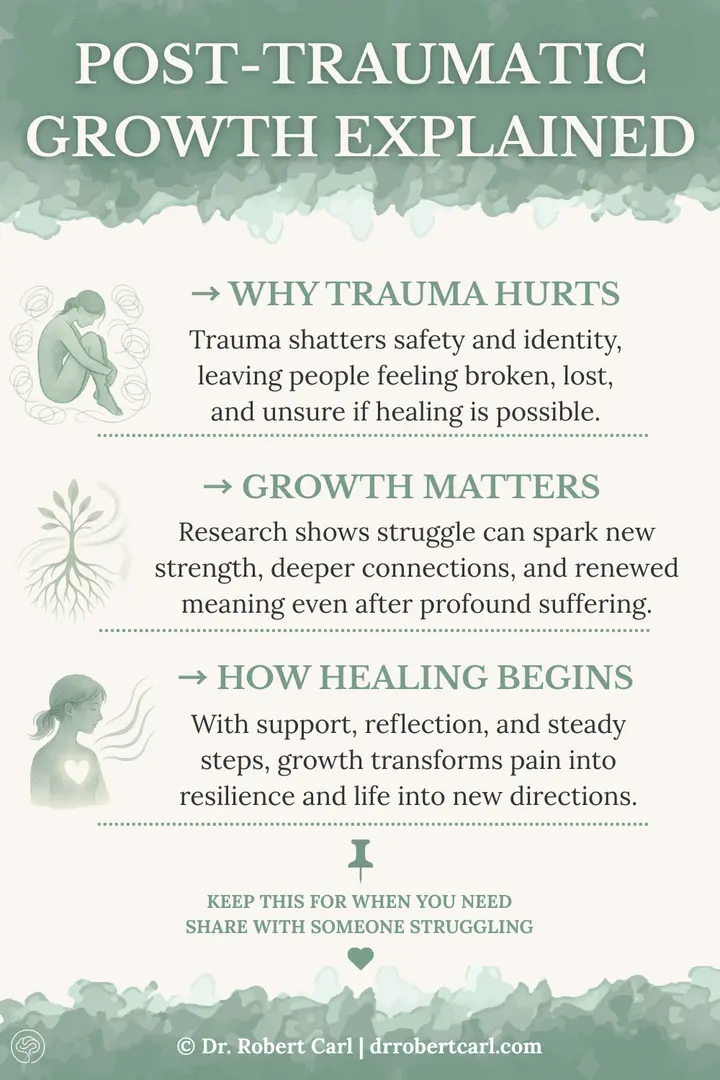
Post-traumatic growth does not erase pain, nor does it make trauma “worth it.”
What the science shows us is something both sobering and inspiring: out of struggle, many people discover new possibilities, stronger bonds, and a renewed sense of meaning.
Growth is not about returning to who you were before, but about creating a self that carries both the scars and the wisdom of what you’ve endured.
If you’ve recognized yourself in these stories and studies, take heart: your body and mind are capable of adaptation.
Healing is never a straight line, but the evidence reminds us that transformation is possible, even in the aftermath of profound challenges.
Trauma reshapes the nervous system in specific ways — and those ways often become the anxiety pattern you carry long after the experience itself has passed.
Understanding that pattern is not about revisiting what happened. It is about recognizing how your system learned to protect you, so you can gently teach it something new.
The free quiz takes two minutes and gives you a clear place to begin.
Disclaimer: This article is for educational purposes only. It is not a substitute for medical or psychological care. If you are struggling with trauma, PTSD, or overwhelming emotions, please seek support from a licensed mental health professional. If you are in crisis, call emergency services (911 in the U.S.) or reach out to the Suicide & Crisis Lifeline at 988. You are not alone, and help is available.
Medically reviewed by Dr. Robert Carl — physician with 45+ years of clinical experience in mental health. Last reviewed: October 3, 2025.
Scientific References
Tedeschi, R. G., & Calhoun, L. G. (1996). The Posttraumatic Growth Inventory: measuring the positive legacy of trauma. Journal of Traumatic Stress.
Tedeschi, R. G., & Calhoun, L. G. (2004). Posttraumatic Growth: Conceptual Foundations and Empirical Evidence. Psychological Inquiry.
Taku, K., Cann, A., Calhoun, L. G., & Tedeschi, R. G. (2008). The factor structure of the posttraumatic growth inventory: a comparison of five models using confirmatory factor analysis. Journal of Traumatic Stress.
Cann, A., Calhoun, L. G., Tedeschi, R. G., Taku, K., Vishnevsky, T., Triplett, K. N., & Danhauer, S. C. (2010). A short form of the Posttraumatic Growth Inventory. Anxiety, Stress, & Coping.
Tedeschi, R. G., Cann, A., Taku, K., Senol-Durak, E., & Calhoun, L. G. (2017). The Posttraumatic Growth Inventory: A Revision Integrating Existential and Spiritual Change. Journal of Traumatic Stress.
Wu, X., Kaminga, A. C., Dai, W., Deng, J., Wang, Z., Pan, X., & Liu, A. (2019). The prevalence of moderate-to-high posttraumatic growth: a systematic review and meta-analysis. Journal of Affective Disorders.
Ning, J., Tang, X., Shi, H., Yao, D., Zhao, Z., & Li, J. (2023). Social support and posttraumatic growth: A meta-analysis. Journal of Affective Disorders.
Tsai, J., El-Gabalawy, R., Sledge, W. H., Southwick, S. M., & Pietrzak, R. H. (2015). Post-traumatic growth among veterans in the USA: results from the National Health and Resilience in Veterans Study. Psychological Medicine.
Shakespeare-Finch, J., & Lurie-Beck, J. (2014). A meta-analytic clarification of the relationship between posttraumatic growth and symptoms of posttraumatic stress disorder. Journal of Anxiety Disorders.
Vrontaras, N., Koulierakis, G., Ntourou, I., Karakatsoulis, G., Sergentanis, T. N., Kyrou, D., Kapetanakis, A., Karademas, E., & Karamanidou, C. (2023). Psychosocial interventions on the posttraumatic growth of adults with cancer: A systematic review and meta-analysis of clinical trials. Psycho-Oncology.
Shaygan, M., Khaki, S., Zarei, D., Moshfeghinia, R., Beheshtaeen, F., & Sadeghi, Y. (2024). Effects of meaning-based psychotherapy on post-traumatic growth and death anxiety in patients with cancer: a systematic review and meta-analysis. Supportive Care in Cancer.
Machinga-Asaolu, R. O. (2025). Post-Traumatic Growth Promoting and Inhibiting Factors Among Intimate Partner Violence Survivors: A Systematic Review. Trauma, Violence, & Abuse.